
Dalit–Palestine Solidarities Against Empire
On Environmental Casteism and Settler Colonialism

A community submission by David Sathuluri / @david_satuluri on IG
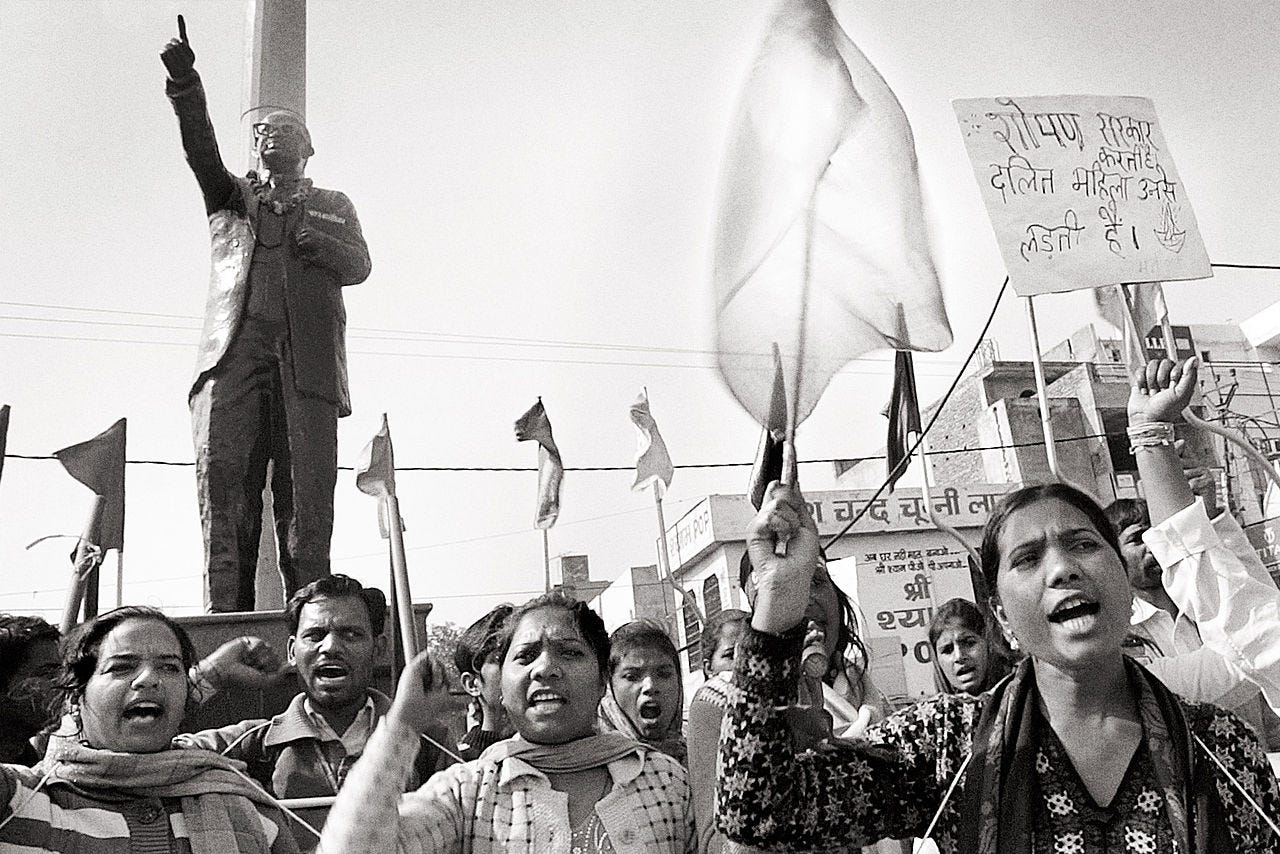
Dalits in India and Palestinian struggles are often framed as separate tragedies, each allegedly rooted in local ancient hatreds or unfortunate geography. In reality, both are structured by global regimes that decide whose bodies, lands, and futures are disposable. Environmental casteism in India and Zionist settler colonialism in Palestine are two articulations of the same imperial grammar that organizes climate catastrophe today.
If climate politics had any integrity, these would be starting points. Instead, mainstream climate discourse turns Caste into a social issue and Palestine into a conflict, politely quarantined from discussions of mitigation, adaptation, and green finance. The result is a form of climate talk that can condemn emissions but not occupations, that can hand‑wring about vulnerability while refusing to name who is doing the wounding.
In Caste‑affected regions of South Asia, Dalits live the climate crisis as an intensification of an older order. More than 260 million Dalits worldwide face a hidden apartheid of segregation, forced labour, and systematic exclusion from water, land, sanitation, and basic services. Their homes are pushed to the peripheries of villages and cities, on flood‑prone or low‑lying land, near dumps, drains, and sewage — zones that become uninhabitable first as heatwaves, floods, and storms intensify.
The language for this is already with us which is known as environmental casteism. Scholars like Mukul Sharma and activists have detailed how caste structures exposure to pollution, waste, and climate hazards; how upper Castes monopolise irrigation, wells, and productive land; how Dalit communities are relegated to ecologically vulnerable areas with limited water access and heightened exposure to floods and droughts. Dalit women walk long distances because they are barred from upper‑caste handpumps; wells are “purified” after Dalits use them; asserting water as a common right can trigger violence. Climate disasters don’t create these patterns; they arrive already mapped onto them.
Palestinians under occupation live a structurally similar environmental order. In the occupied territories, climate change is experienced through a matrix of military control over water, land, and infrastructure. Israeli authorities exploit Palestinian and Syrian resources while preventing Palestinian communities from pursuing even basic adaptation measures.Palestinians and Israelis inhabit the same climatic region, but not the same climate risk if we can see. The zionist occupation itself has been described by UN agencies as an environmental risk in its own right, a system that amplifies every drought, heatwave, and flood for those under blockade and siege.
Gaza makes the convergence brutal and undeniable. Decades of blockade, bombing of water and power infrastructure, contamination of aquifers, and destruction of farmland have produced what Palestinian movements rightly name as genocide and ecocide. These are not side‑effects of war; but are the methods. As civil societies have argued, “climate justice and Palestinian liberation are inseparable,” because the same corporations and states that profit from fossil fuels and militarism are materially enabling Israel’s settler project.
Seen together, environmental casteism and settler colonialism expose how climate breakdown is governed as a problem of order, not of survival. Dalit communities are expected to absorb floods, pollution, and displacement because their suffering is already discounted in the caste ledger. Palestinians are expected to die quietly behind walls and checkpoints so that so-called green states can claim stability and democratic normalcy.The climate movement’s reluctance to treat these as central, rather than peripheral, is not an accident; it is a symptom of its own capture by imperial common sense.
Imperial common sense works by misnaming. Caste is reduced to poverty, obscuring the deliberate social and spatial design that pushes Dalits onto toxic land and precarious labour. Palestine is reduced to security, treating the occupation’s control over water, movement, and agriculture as regrettable necessities rather than mechanisms of domination.In each case, the violence that structures vulnerability is rebranded as context, unfortunate but somehow outside the frame of climate policy.
A Dalit–Palestine climate politics starts from the opposite premise, that there is no meaningful way to talk about adaptation without talking about who owns the land, who controls the water, who polices the borders, and whose bodies are treated as expendable infrastructure. It listens to Dalit organisations demanding caste‑aware climate plans and legal recognition of Dalit resilience as a matter of obligation, not charity. It listens to Palestinian movements insisting that any serious climate agenda must include ending arms trade, fossil‑fuelled militarism, and the corporate complicity that binds energy, agribusiness, and occupation together.
Solidarity here is not an aesthetic posture but as a method for identifying the actual infrastructures we have to confront. When Dalit thinkers describe how eco‑casteism has caste‑ised India’s ecological landscape — from tanneries and brick kilns to slums and sewage — they are naming the same kind of social cartography that Palestinians describe when they talk about settler roads, closed military zones, and the wall. Both are describing political technologies that sort life into zones of protection and abandonment.
There are already fragments of explicit Dalit–Palestine solidarity like statements, joint events, shared platforms with other racialised and migrant communities that name Israel as a settler‑colonial state and align with the Palestinian‑led Boycott, Divestment, Sanctions (BDS) movement. These are the experiments in building a political horizon where annihilating caste and dismantling Zionism are treated as conditions for climate justice, not optional add‑ons.
For an archive like The Resistance Archives, telling this story is not just about collecting testimonies of suffering but also about refusing the separation that says Dalit struggles belong in caste folders, Palestine in Middle East conflict, and climate somewhere else entirely. It is about insisting that environmental casteism and settler colonialism are key nodes in the same imperial network that is burning the planet and then selling us adaptation plans at interest.
Solidarity, in this frame, is less a slogan than a diagnostic. If our climate politics cannot find its way to Dalit bastis and to Gaza’s rubble, if it cannot name caste and Zionism as climate infrastructures, then it is not climate justice — it is climate management for the empire. The task is to write, organise, and remember against that management, until the worlds that environmental casteism and settler colonialism have tried to bury can breathe again.